Why Premium Domains Cost What They Do: A Buyer's Guide for Funded Startups

There are two prices for a domain name. One is about ten dollars a year at a registrar. The other is five or six figures, paid once, to whoever already owns the name you actually want.
Founders seeing that gap for the first time usually assume the second number is made up. It isn't. It's the clearing price in a market with permanently fixed supply and a buyer pool that has gotten considerably richer over the last three years. The question worth asking is not why the name costs $25,000. It's whether $25,000 is the right price for what it does for you, and that answer depends almost entirely on how much capital you've raised and how visible you're about to become.
If you closed a round in the last eighteen months and you're currently operating on a hyphen, a deliberate misspelling, or a country-code extension you're renting, this is written for you.
The supply problem is the whole story
Every short, pronounceable, commercially useful English word in .com was registered years ago. So was every clean two-word combination in the obvious business categories. There is no new supply. The registry cannot mint more of them, and the existing holders are under no pressure to sell.
That's what makes the aftermarket the only market. When you buy a premium domain, you are not buying a service or a hosting product. You are buying a specific, non-reproducible asset off a private holder who has probably already turned down offers. The price reflects scarcity and the buyer's alternatives, not the seller's costs.
The headline transactions make the logic legible. Voice.com traded at $30 million in 2019. Chat.com sold for $15.5 million in 2023 and was acquired by OpenAI the following year. Rocket.com went to Rocket Companies for $14 million. In early 2026, AI.com was reported at roughly $70 million, the largest publicly recorded sale on the books, purchased ahead of a Super Bowl launch.
Those numbers are not your budget. They matter because they set the ceiling that everything below them is priced against, and because they demonstrate what sophisticated, well-capitalized buyers believe a category-defining front door is worth.
What actually makes a name premium
"Premium" is not a marketing label a seller applies. It's a set of properties that hold up under scrutiny. Six of them do most of the work.
The extension. Despite twenty years of alternatives, .com remains the default assumption in a buyer's head. People type it, say it, and mishear other extensions as it. Every non-.com brand pays a small, permanent tax in traffic leakage and correction.
Length and syllable count. Short names survive being spoken. They fit in an email signature, a logo lockup, a conference badge, and a URL bar on a phone. Length is the single most reliable predictor of aftermarket value.
Lexical clarity. A name built from real words that describe what you do arrives pre-loaded with meaning. It requires no explanation and no education budget. That's why category descriptors trade at multiples of coined equivalents.
Spellability under pressure. The real test is whether someone can hear the name once, on a bad phone connection, and type it correctly. Dropped vowels, doubled consonants, and clever substitutions all fail this test, and they fail it forever.
Category headroom. Buy for the company you'll be in five years, not the product you're shipping this quarter. A name that describes your current feature becomes a constraint the moment you expand. A name that describes your capability does not.
Clean provenance. Registration age, prior use, backlink profile, and blocklist status all travel with the name. An aged domain with a legitimate history is an asset. An aged domain that once hosted an affiliate farm is a liability wearing the same clothes.
The buyer's math
The reason funded companies pay premium prices is not vanity. It's that the number is small relative to everything else on their P&L, and it's a one-time cost that replaces a recurring one.
Put a $25,000 domain next to the alternatives. It's roughly one engineer-month at loaded cost. It's a fraction of a single quarter's paid acquisition spend at most Series A companies. On a $5 million seed round it's half a percent. Amortized across the life of the company it rounds to nothing.
Now put it next to what a weak name costs. Every ambiguous or misspelled name creates permanent drag: correction in every sales call, traffic leaking to the .com you don't own, higher paid-acquisition costs because you're bidding against confusion, and support load from customers who can't find you. That drag compounds quarterly and never stops.
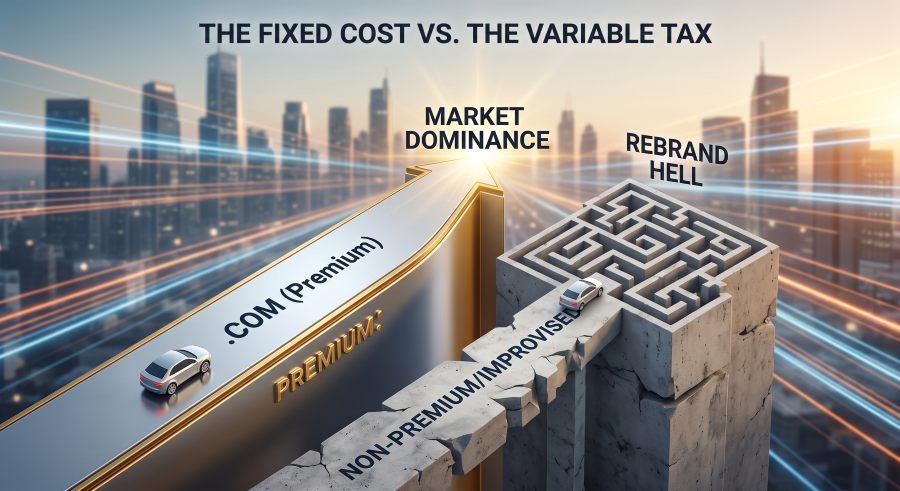
The asymmetry is the point. A premium name is a fixed cost paid once. An improvised name is a variable cost paid forever, and it ends with a rebrand.
The .ai question
For AI companies specifically, this deserves a direct answer, because the extension has become the default and the default is worth examining.
.ai is Anguilla's country-code extension. It has grown from a quiet ccTLD to well over 1.2 million registrations, and it now funds close to half of that territory's government revenue. Google treats it as a generic extension with no geographic targeting penalty, so there is no SEO argument against it. It brands an AI product cleanly, availability is far better than .com, and a large share of recent Y Combinator AI startups use it as their primary domain.
All of that is real. Three things sit alongside it.
First, it's a lease, not a deed. Registrations carry a mandatory two-year minimum, and the wholesale registry price rose again in March 2026. The cost floor is set by registry policy in a jurisdiction with a strong incentive to keep raising it.
Second, extensions date you. The .ly generation and the .io generation both looked like permanent standards while they were the standard. Naming conventions are fashion, and fashion resolves.
Third, and most practically: the price of the matching .com goes up the moment you become visible. The cheapest time to acquire it is before your Series A press cycle, not after. Teams that wait end up negotiating with a seller who has read the funding announcement.
None of this means don't use .ai. It means treat it as a product brand and treat the .com as the terminal asset. Acquire it early, redirect it if you're not ready to migrate, and stop paying the correction tax on every sales call. The aftermarket has already priced in the sector's interest; in February 2026, bot.ai cleared $1.2 million on Sedo, the first publicly recorded seven-figure .ai sale.
Running on .ai and wondering what the matching .com would cost? Our portfolio lists every name with buy-now pricing, sorted by category. No offer process required to find out.
The bill you're avoiding
The strongest argument for buying the right name once is the cost of buying it twice.
A rebrand at Series B is not a logo exercise. It's trademark clearance and filing in every operating jurisdiction, contract and invoice amendments, an email deliverability reset that puts your entire outbound domain reputation back to zero, the loss of accumulated search equity on a domain your customers have bookmarked, app store listings, integration directory entries, documentation, support macros, and a press narrative you didn't want to spend a cycle on.
Most teams that do it describe it as two quarters of distraction absorbed by the people who could least afford to be distracted. Against that, a five-figure domain purchase in year one is cheap insurance.
Where the name earns its price
Three rooms, specifically.
Fundraising. Investors read the domain before they read the deck. It functions as a proxy for how the team allocates capital and how seriously they take permanence. A hyphenated or off-extension domain doesn't lose the meeting, but it's one more small signal on the wrong side of the ledger.
Enterprise procurement. Security reviews, vendor onboarding, and legal all treat an established, unambiguous domain as a stability signal. A name that looks provisional invites questions about whether you'll exist at renewal.
Hiring. Senior candidates are evaluating you as much as you're evaluating them. The name is the first artifact they see, and it either reads as a company or as a side project.
A worked example: what a name looks like once it's operating
Everything above treats a domain as a defensive purchase. It can also be the starting point of the business, and we build that way ourselves, so here is one of ours with the process attached.
JobBands.com existed as a name before it existed as a product. "Job bands" is not a brand we invented. It's the phrase an HR generalist at a 60-person company types into Google the week a pay transparency deadline lands on their desk and they realize the compensation structure is four spreadsheets and an inherited Word document. That is the entire reason the name is worth owning.
The name told us what to validate. Before any code, the question was whether real, non-discretionary spend sits behind that search phrase. It does, and it's legislated. As of 2026, 18 US states plus Washington D.C. require salary ranges in job postings. California enforces violations at $1,000 to $10,000 per posting, and Ontario's Employment Standards Act assesses up to CAD $10,000 for a first offence. The existing options are a spreadsheet the HR generalist maintains for 40 to 80 hours a year with no benchmarks and no audit trail, or an outside compensation consultant at $5,000 to $25,000 for a one-time PDF that's stale within twelve months. Demand created by regulation is the most durable kind, because nobody gets to defer it.
The name also told us what not to build. JobBands.com is a promise with edges. It builds job bands. It is not an HRIS, it does not run payroll, and it does not do performance reviews, because the name doesn't claim to. A descriptive domain is a scope fence, and that turns out to be more valuable than it sounds. Most SaaS products die of feature sprawl, and a name that makes sprawl feel wrong is a permanent, free constraint on the roadmap.
One name, three surfaces, live on day one. The domain carries a marketing site, a store selling practical Excel tools between $35 and $49 (a band structure builder, a pay transparency posting kit, a compensation philosophy workbook), and a content hub publishing jurisdiction-by-jurisdiction compliance guides. None of that required the software to exist yet. The store monetizes traffic from the first visitor, and someone who pays $45 for a posting compliance kit has self-identified as having the problem and a budget, which makes them the shortest path to a software customer later.
Where the exact-match name compounds. This is the part that surprised us. JobBands.com is among the strongest organic performers in our portfolio, ahead of lines we'd have picked as favourites. It's worth being precise about the mechanism, because it is not the old exact-match bonus. Google removed most of that ranking multiplier more than a decade ago, and a keyword domain does not outrank better content. What a matching domain does is corroborate. An article about California's disclosure rules is more obviously on-topic when it sits on a domain that says job bands, and on a results page where several listings hold similar positions, the one whose domain matches the query takes a disproportionate share of the clicks. The lift is topical coherence and click-through, not algorithmic favour. That's precisely why it compounds under every article published behind the name instead of boosting any single one.
To be straight about status: the software is in testing behind a waitlist with published tiers, so this is a worked process, not a revenue claim. The point is what the name did before there was anything to sell. It supplied the demand signal, the positioning, and the scope boundary.
The corollary matters for your own purchase. This only works because the name is a phrase practitioners actually search. That's the real fork in the road when you're buying. A descriptive name buys existing demand you don't have to create, at the cost of being harder to trademark and harder to pivot. A coined name buys memorability, clean trademark room, and unlimited category headroom, at the cost of an education budget. Neither is better. They're different assets, and which one you need depends on whether you're entering a category buyers already search for or creating one they don't.
How to price one, and how to diligence it
Do this in order, and do the legal work before the negotiation.
Use comparable sales, not appraisal tools. Automated valuations are noise. Public sales databases showing what similar names actually cleared at are the only defensible anchor.
Clear the trademark first. Search the USPTO register and check for common-law use in your category. A name that reads perfectly and infringes is worth nothing.
Check the history. Pull the archive record, look at the backlink profile, and confirm the name isn't sitting on a spam blocklist. Prior use is inherited.
Insist on escrow. Funds release against confirmed transfer, always. Reputable marketplaces build this in.
Know your two paths. Buy-now pricing is fast and final. Making an offer takes longer and sometimes works. Payment plans over 12 to 24 months are widely available and let you take the name off the market immediately without a lump-sum hit.
When not to pay a premium
Discipline runs both directions. Don't buy one if you're pre-product with no capital and no committed direction, because you'll pay twice when the thesis moves. Don't buy one purely for SEO: as above, the ranking multiplier is gone, and what remains is corroboration and click-through, which is real but will not rescue thin content. The case for a premium name is brand, trust, and conversion. And don't buy one to solve a positioning problem. A name can't fix an unclear product.
Where we sit
We operate a portfolio of more than 400 .com names and, as the JobBands example shows, we build our own products on them. That puts us on both sides of this trade, which is why this piece has a section on when not to buy.
Every name we list is a .com, categorized by sector, priced transparently with no offer theater, and transacted through Atom with escrow on every purchase. The inventory covers both halves of the fork above: descriptive category names in AI, data, workforce, fintech, and healthcare, and short coined brandables for teams who need trademark room instead of search demand. Most of it sits between $1,000 and $25,000.
If you've raised and you're still on a name you'd rather not defend in a board meeting, that's the signal. Browse the portfolio, or get in touch and tell us what you're looking for. We'll tell you if we have it and if we don't.