From Domain to Live Product: How We Take a Niche to Market
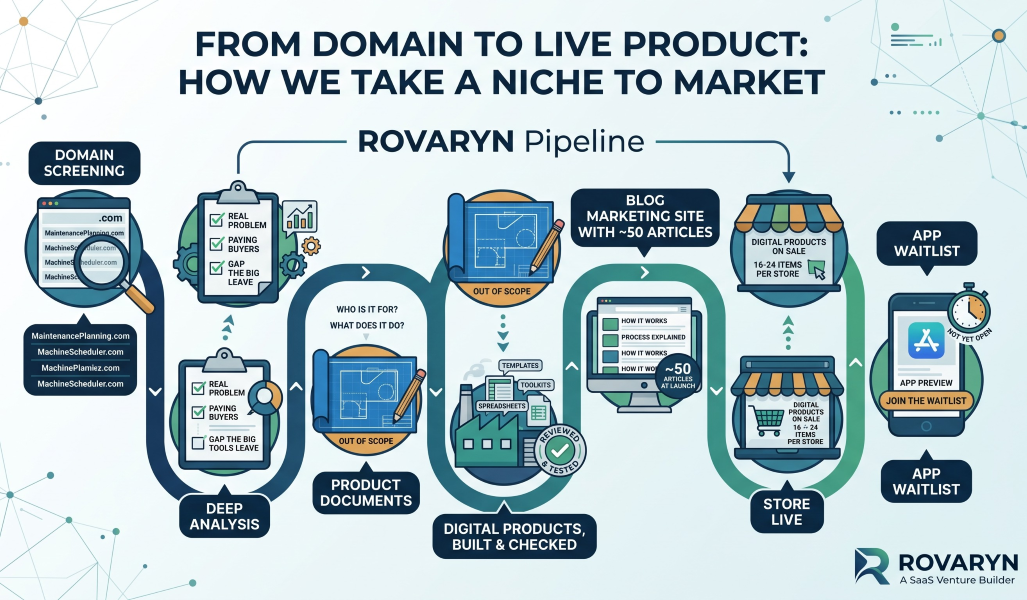
Take a name like MaintenancePlanning.com. On day one it is just a domain. A few stages later it is a product: a marketing site with a blog, a store of templates people can buy today, and a software app with a waitlist. Every Rovaryn product goes through the same stages in the same order, and the order matters more than any single step.
This post walks through that pipeline, stage by stage, and explains the choice people ask about most: why the digital products ship before the software.
The pipeline at a glance
Here is the whole path, from first look to launch:
Domain screening. A quick, consistent pass to decide which names are worth a closer look.
Deep analysis. A careful study of the niche behind each name that survives screening.
Product documents. A written definition of who the product is for, what it does and what it will not do.
Digital products, built and checked. Templates and toolkits for the same buyer, built from those documents and reviewed before they go on sale.
Marketing site with about 50 articles. Content that answers the buyer's real questions.
Store live. The digital products go on sale.
App waitlist. The software is announced honestly as not yet open, and interested buyers can join a list.
Each stage is a gate. A name that fails one does not move on to the next, and a stage that is not finished does not get skipped to keep a schedule.
Stage 1: screening the domain
We start from names, not ideas. A descriptive .com in a narrow B2B niche tells you who the buyer is and what job they need done before anything is built. MachineScheduler, WorkTickets and LicenseRoadmap all say their purpose out loud.
In July 2026 we ran a screening sweep over 412 domains. The point of that first pass was consistency, not depth: every name got the same short questions, asked the same way, so that no domain won just because it was reviewed early or by someone who liked it.
One thing we did not screen for was search ranking. Google's own SEO Starter Guide says that "keywords in the name of the domain (or URL path) alone have hardly any effect beyond appearing in breadcrumbs". A clear name helps a person understand a product at a glance. It does not do the marketing.
The names we did not build on are not wasted. Rovaryn lists premium domains for sale at fixed prices on our domains page, for founders who want a strong name for their own company.
Stage 2: deep analysis of the niche
Screening tells you a name might be interesting. Deep analysis tells you whether there is a business behind it. For each candidate we look at three things:
A real, recurring problem. Not a category like "scheduling", but a specific task a specific person struggles with every week.
Buyers who pay. A problem that costs a business time or money, so that solving it is worth a budget line.
A gap the big tools leave. Our thesis is markets that are too small for enterprise vendors and too specialized for generalist platforms. We wrote about it in The Opportunity in "Too Small".
This is where most of the judgment happens, and it is the stage most worth slowing down for. A name that looks strong on a screening sheet can turn out to describe a problem nobody budgets for. Better to find that out here than after the build.
Stage 3: the product documents
Before anything gets built, the product is written down. The documents cover who the buyer is, the jobs they need done, the features that matter, and what is deliberately out of scope.
They are the source every later stage draws from. The digital products, the site copy, the article topics and the app's feature list all come from the same written definition. That is how a single product stays coherent across three very different layers: if the store sells a template, the blog explains the problem it solves, and the app is designed to do the same job in software, they all describe the same buyer and the same work.
It also keeps us honest about scope. A focused product is easier to explain, easier to build and easier to check. We covered the case for narrow scope in Shipping a Focused B2B SaaS in Weeks, Not Years.
Stage 4: digital products, built and checked
Next come the digital products: templates and toolkits the buyer can use straight away. Each store launches with about 20 of them, and the range across the portfolio is 16 to 24 per store.
"Checked" is the important word. A template that opens with an error, or a spreadsheet whose formulas point at the wrong cells, is worse than no template at all, because the buyer trusted it. So each product is reviewed against what it claims to do before it goes on sale, and a product that fails review goes back to be fixed rather than out the door.
Why digital products ship first
This is the question we get most, so here is the direct answer. The digital products ship before the app for four reasons.
They are useful now. A buyer with a problem today does not have to wait for software. A good template solves part of the problem immediately, often in a tool they already have open.
They test the definition. The product documents describe a buyer and their work. A store full of products built for that buyer is the first real-world test of whether the description is right. If buyers want different tools from the ones we expected, that is something to learn before writing the app, not after.
They are honest. We do not want a product page that sells something that does not exist yet. A live store means every product has something real on sale from the day the site opens, while the app is clearly labelled as a waitlist.
They earn from the start. The store is the layer that can bring in revenue from the first day, which means the product does not depend entirely on a future software launch. The broader logic of running many focused products this way is in Why We're Building a SaaS Venture Builder Instead of a Single Product.
Stage 5: a marketing site with about 50 articles
Each product launches with a marketing site and a blog of about 50 articles, then adds 8 new articles a month after that.
The articles answer the questions a buyer in that niche actually asks: how a process works, what a rule requires, how to do a task better. That follows Google's guidance on creating helpful, reliable, people-first content, which separates content made primarily for people from content made primarily to rank, and lists producing lots of content on many topics in the hope some of it performs as a warning sign.
Volume alone is not the goal, and Google is explicit about the risk. Its spam policies define scaled content abuse as "when many pages are generated for the primary purpose of manipulating search rankings and not helping users", however the pages are produced. So every article has to earn its place: one buyer's question, answered with facts that can be checked.
We also do not promise ourselves quick results. The same SEO Starter Guide notes that "some changes might take effect in a few hours, others could take several months". Content is a long-term layer, which is one more reason the store ships alongside it rather than after it.
Stage 6: the store goes live
With the digital products checked and the site published, the store opens. Every one of our products has its store on sale now. You can browse the full portfolio on our products page, or start with a single line such as MaintenancePlanning, whose tagline is "Preventive maintenance planning without the spreadsheet."
Stage 7: the app waitlist
The last layer is the software, and it is the one we are most careful to describe accurately. Every Rovaryn app is on a waitlist. None is open for sign-up yet, so we do not describe any of them as available, and the sites invite buyers to join the list rather than to start using the software.
A waitlist is the honest label for where the app stands. It also tells us which buyers want the software most, which is useful when deciding what to build first.
What the order buys us
Put together, the sequence does three things.
It spends effort where the evidence is. Screening is cheap and broad; deep analysis is expensive and narrow; building comes last. Each stage only gets the names that passed the one before.
It keeps three layers describing one product. Because everything comes from the same product documents, the store, the blog and the app point at the same buyer and the same job.
It keeps status labels true. The store is live because it is finished. The app is on a waitlist because it is not. Nothing on the site says otherwise.
That is the whole pipeline: names screened first, then each product built with a site, about 50 articles at launch, a live store of around 20 digital products, and an app waitlist. The next stage for each of them is the software, and it will get the same treatment: built against the documents, checked, and labelled honestly when it opens.