Brandable vs Keyword Domains for a B2B Startup
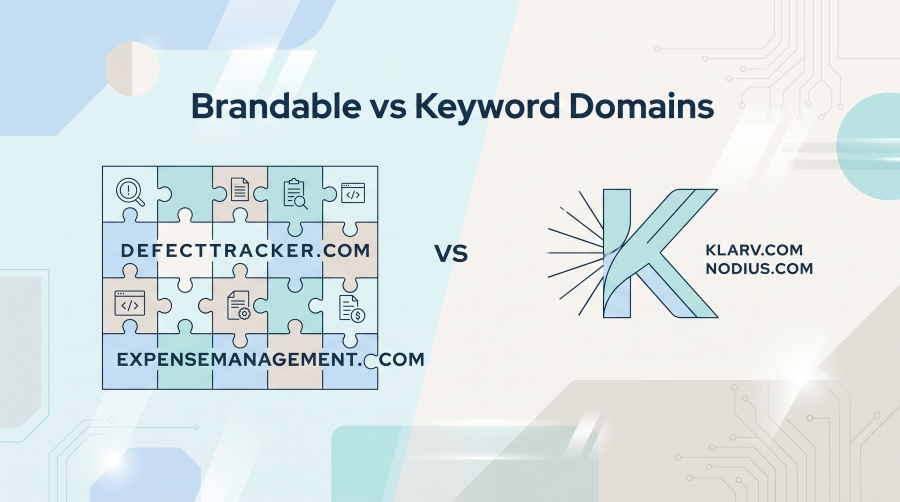
You have two names on the shortlist. One says exactly what the product does, like MachineScheduling.com. The other is a word nobody has heard before, like Klarv.com. The first needs no explanation in a sales call. The second needs explaining every time for the first year, and after that it may be the only one of the two you can really own.
Neither is the right answer for every company. The choice comes down to four things: how people remember the name, how strong a trademark it can be, what it does (and doesn't do) for search, and whether it still fits when the company sells a second product.
What we mean by keyword and brandable
A keyword domain (also called descriptive or exact-match) is made of the words a buyer would use for the product or category: ClaimsIntake.com ($4,848), DefectTracker.com ($12,999), ExpenseManagement.com ($24,999).
A brandable domain is a name with no fixed meaning in your market. It might be an invented word such as Klarv.com ($17,999) or Nodius.com ($24,999), or a real word used in a new setting. You can browse a full set of coined names in our brandable-coined category.
There is a middle ground too: names that hint at something without describing it. BuzzForms.com ($4,384) and Rankbotics.com ($9,999) are examples. As the trademark section below shows, that middle ground matters more than it looks.
Memorability: clarity now vs distinctiveness later
Keyword names win on first contact. If a plant manager hears "MachineScheduling.com" on a call, they know what it is and can probably type it from memory. The name does some of the selling for you. That is a real advantage for a small B2B company that can't afford much brand-awareness spending.
The weakness shows up later. Descriptive names are easy to mix up with each other. If a buyer has looked at three tools with "schedule" or "planner" in the name, two weeks later they may not remember which one they liked. A generic phrase is easy to recall as a category and hard to recall as your company.
Coined names flip this. Nobody knows what "Klarv" means at first, so it takes more work to make it stick: a clear tagline, repetition, a product people talk about. Once it does stick, though, it points to one company only. There is no category it can blur into.
In practice:
Keyword names suit companies that sell one clear thing to buyers who search for that thing, and that need to explain themselves in a single line.
Coined names suit companies that expect to spend on marketing anyway, plan to grow past one product, or work in a crowded category where descriptive names all sound the same.
Trademark strength: the spectrum of distinctiveness
This is where the two styles differ most, and where founders are most often caught off guard. What follows is a general explanation, not legal advice. Before you commit to a name, talk to a trademark lawyer in your market.
The USPTO sorts marks along a scale from strong to weak. Its guide to strong trademarks puts it plainly: "Strong trademarks are suggestive, fanciful, or arbitrary. Weak trademarks are descriptive or generic."
From strongest to weakest:
Fanciful: invented words that only mean something in relation to the product. The USPTO's examples are Exxon for petroleum and Pepsi for soft drinks. Most coined domain names fall here.
Arbitrary: real words with no link to the product, like Apple for computers.
Suggestive: words that hint at a quality without stating it. The USPTO's example is Coppertone for sun-tanning products.
Descriptive: words that "merely describe some aspect of your goods or services." The USPTO says these are registrable only in certain circumstances, "such as your trademark gaining distinctiveness through extensive use in commerce over many years."
Generic: the common name for the product itself. These, the USPTO says, "are not federally registrable."
Canada works on a similar idea. Under section 12(1)(b) of the Trademarks Act, a mark is not registrable if it is "clearly descriptive" of the character or quality of the goods or services. Section 12(3) makes an exception if the mark has become distinctive by the filing date, taking into account how long it has been used.
What this means for the two styles:
A name like ExpenseManagement.com for expense software sits at the descriptive (or even generic) end. You can own the domain, but you may not be able to stop a competitor from calling their product "Expense Management Pro." Owning the domain gives you the address, not exclusive rights to the words.
A coined name like Nodius sits at the fanciful end. It is usually easier to register and to defend, as long as nobody already uses something confusingly similar.
Suggestive names like BuzzForms are often the practical sweet spot. They hint at what you do, so buyers get some help, while still having a better chance of protection than a purely descriptive phrase. Where exactly a name falls on the scale is a judgement call that examiners and courts make case by case.
Whatever style you pick, search the USPTO trademark database and the Canadian Trademarks Database for conflicts before you buy. A coined name that collides with an existing mark is no safer than a descriptive one.
SEO: what Google actually says
A common reason founders pay up for a keyword domain is the belief that the keywords will help it rank. Google's own guidance says otherwise.
The Google Search Central SEO Starter Guide says that "from a ranking perspective, the keywords in the name of the domain (or URL path) alone have hardly any effect beyond appearing in breadcrumbs." Its advice on choosing a name is to "do what's best for your business" and follow general marketing best practice. The same guide says the domain ending matters only if you are targeting a particular country, and that otherwise Google Search doesn't care which TLD you use.
So a keyword domain doesn't give you a ranking boost. Its real search advantages are indirect:
A searcher who sees "DefectTracker.com" in the results knows what the page is about before clicking.
Other sites that link to you may use your name as the link text, and with a descriptive name that text describes the topic.
Both are small effects. Your content, your product and the links you earn will matter far more to how you rank than which words are in the domain. A coined name gives up very little in search, and over time people searching for your brand name find only you.
Room to grow beyond one product
Descriptive names are tied to what you sell today. If MachineScheduling.com later adds maintenance tracking, quoting and inventory, the name starts working against the product. Buyers assume it only does scheduling. You end up with a choice between a rebrand and a name that undersells you.
Coined names don't have this problem. A word like Klarv can stand for scheduling today and a whole platform later, because it never meant scheduling in the first place.
We deal with this tension ourselves. Each of our products sits on its own .com with a name that says what it does, because each one serves a single narrow niche and buyers need to understand it at a glance. The company that holds them, Rovaryn, has a coined name, because it has to cover all of them and whatever comes next. That split (descriptive for a focused product, coined for the umbrella) is one reasonable pattern, not a rule.
How to decide
These questions usually settle it:
Will you sell one thing or many? One clearly defined product leans keyword. A platform or a portfolio leans brandable.
Do buyers search for the category by name? If they type "claims intake software," a name that matches their words helps them recognise you, though it won't rank you higher.
How much do you care about owning the name? If you want to stop look-alike competitors, a fanciful or suggestive name puts you in a much stronger position.
How much marketing will you do? A coined name needs repetition before it means anything. If your plan is mostly word of mouth in a small industry, a self-explaining name has to carry more of the load.
Does it pass the basics? Easy to say, easy to spell after hearing it once, and no awkward meaning in the languages of your markets. The USPTO's guide suggests checking whether the public "will remember, pronounce, and spell your trademark," and whether it translates badly.
A worked example (an illustration, not a real company): a two-person team is building software for one task in insurance claims, and plans to stay in that niche for years. A name like ClaimsIntake.com explains the product in sales calls and in search results, and they accept that they can't stop others using the phrase. A second team plans to start with claims and expand into underwriting and broker tools. A suggestive or coined name gives them a mark they can protect and a name that won't need replacing when the second product ships.
Pricing reflects both styles
Both styles show up across the whole price range. The domains in this article run from $4,384 to $24,999. Short, clean, pronounceable names cost more whichever style they are, for reasons we cover in why premium domains cost what they do.
Every name in our domain portfolio has a fixed listed price. You buy through Atom.com, with payment held in escrow and a guided transfer that typically takes 1–3 days. Lease-to-own and payment plans are available on Atom. If you have a question about a particular name, get in touch.